RSS

Illustrator of the Week - Erin E. Stead

Caldecott Medal winner Erin E. Stead has illustrated numerous children's books including A Sick Day for Amos McGee, Bear Has A Story to Tell, and her newest book And Then It's Spring. Using woodblock printing techniques and pencil, Erin's art has garnered much attention, having been named a New York Times Best Illustrated Book of 2010 and a Publishers Weekly Best Children's Book of 2010.

http://erinstead.com/


Chomp Book Review

Chomp by Carl Hiassen

Wahoo's family owns a wildlife refuge, full of all manner of beasties from pythons, to parrots, to a 13-foot alligator named Alice, the very animal responsible for Wahoo's missing thumb. After Wahoo's father, Mickey is struck on the head by a frozen Iguana, the family falls on hard times and in their desperation they agree to be animal handlers for Expedition, Survival!, a not-so-reality based show in which Derek Badger goes into the wild (or into Wahoo's backyard), fighting off all manner of dangerous creatures, or in this case, the rather docile Alice. Things turn bad though when Wahoo and his dad agree to go to the Everglades along with the TV crew and a girl named Tuna, whose abusive father is not far behind.

Having only read Hoot, which was rather light despite the environmental message, I think I was expecting something along those lines. I was pleasantly surprised by the depth of this novel, so much more than Hoot and yet still light enough for young readers. Wahoo, despite his wacky name, is a kid who has been forced to grow up quickly, taking on the role of manager while his mother is off in China and his father is still suffering from his iguana attack. Smart, witty, and quick thinking, Wahoo is the perfect foil for his speak-before-he-thinks father. Mickey, is a great complex adult character, the kind I rarely see in children's novels, albeit usually the adults are simply missing in middle grade books. Derek Badger is plenty the imbecile and once he gets to the real wild, the Everglades, his idiocy is ramped up to the point of bizarre...and it is wonderful. Tuna was the only character who I felt was a little unlikely, but Hiassen weaves her and her abusive father into the plot so deftly that I barely gave notice while reading.

After some research, I think this may be one of Hiassen's darker novels for young readers, but it was handled well and even though there were serious issues involving abuse and guns and such, Hiassen is careful to keep his intended audience in mind. That said, teachers and librarians should keep in mind that this novel has a bit more bite. Or Chomp.

Scarlet Review

Scarlet by A.C. Gaughen

Will Scarlet, aka Scarlet, is a thief. And a female, although this is mostly unknown outside of Robin Hood's band of merry "men". Hiding a dark past, Scarlet steals and fights for Rob, frustrated by her own tumultuous feelings regarding men, especially Rob and Little John. When Guy of Gisbourne, a notorious thief catcher, is hired by the Sheriff of Nottingham, Scarlet's secret is threatened. A secret that could very well get her killed, or worse, married.

The Robin Hood ballad has always been a favorite of mine, Howard Pyle's compilation of stories The Merry Adventures of Robin Hood is one my favorite books. I own and watch frequently the 1936 Errol Flynn movie by the same title as well as the anthropomorphic Disney classic. Amazing authors like Rosemary Sutcliff, Geoffrey Trease, Robin McKinley, and Theresa Tomlinson have all flirted with the notorious outlaw. Cynthia Voight wrote an interesting tale called Jackaroo that was reminiscent of Robin Hood, with a female as the main character. Robin Hood has been made into movies, TV shows, songs, comic books, and even a Lego set, which, of course, I owned)

I say all this to express my absolute love for this classic tale and how I am generally happy with the different retelling that has been created over the years. However, I am afraid that Scarlet was not my favorite addition to this 'genre'. (if I can call it that)

Scarlet's constant prattling about men and boys and her flirtations, that she swears are not, with Little John and Robin were the bulk of the story. Even her deep dark secret, which I promise not to reveal, revolved around this theme. I liked that Scarlet was a girl, it was a fun twist on a classic story, but there was far too much inner monologue and the story, which has always been one of adventure and action, became nothing but a angsty love triangle. The reader is never really allowed to get to know neither Robin nor Little John outside of Scarlet's twisted versions of them, which makes her a rather frustrating and unreliable narrator, even for her own life and feelings. The author relys on the reader's foreknowledge of the two main male characters as character development. We all know who Robin ends up with and it definitely is not Will Scarlet, so where is this story going? When the secret is revealed, I wanted to bang my head against the table because I saw it coming and I was just hoping that the author wasn't going there.

Scarlet is not badly written and I imagine that the girls who prefer romance, would enjoy it. Although I found the book cloying, it wasn't all bad and I did feel the need to finish it. Scarlet is a rather adventurous story with plenty of action and knife throwing. The love triangle is definitely original, but it could have been so much better, which is important when retelling something that has been told again and again for centuries.

Insert Romantic Cliche Here

As a teen I was what you would call a late bloomer. I wasn't very interested in boys nor was I interested in the girls who were obsessed over them. I preferred watching movies and reading books and going out places with my friends. We once invented a game called pan ball in which you went to Wal-mart, got a pan from the pan aisle and a ball from the ball aisle and then proceeded to play a version of tennis in which the only rules were don't break anything. Ahh, to be young. Even when I did begin dating, I think it was more for the...this is what you do not necessarily because I was boy crazy.

Now that I am an adult, I have to say, the plight of the teenage dating process doesn't interest me in the slightest. Neither does the breakup process concern me. This may be because I know that for very few of these teens, the relationships they have at fifteen are lasting. Sure it leaves a psychological impact, but it is just not something I care about.

This does not mean that I think these books are badly written in the least. Clearly they fulfill an emotional need and many teenagers can relate to them. All I am saying is that there are some books that I am more likely to avoid. If the occasional romance shows up then so be it, but an entire book about love and dating or breaking up is not something I would pick up on my own. In other words, Romance is not my genre.

Which is why books like the following often have characters and storylines that I just can't seem to care about and they will rarely be blogged about:


Just thought I would clear that up for some of my readers who wonder why I don't review more of these types of books.

When Things Come Back Book Review

When Things Come Back by John Corey Whaley

Cullen Whitter hates his boring ass-hat town, full of boring ass-hat people and dreams of the day when he can escape. Until then he suffers through saved only by his best-friend Lucas and his very cool little brother Gabriel. Then an ego-centric birdwatcher announces that he has discovered the extinct Lazarus Woodpecker. This discovery puts Cullen's small town on the map, but while everyone else is going Lazarus crazy, the Whitter family is desperately searching for Gabriel who has mysteriously gone missing. Interweaved within the novel is a second plot in which a young missionary goes to Africa and loses his faith and this seeming innocuous event leads a chain of events that will change Cullen's life forever.

Winner of the Printz Award for Excellence in Young Adult Literature, I obviously felt obligated to read this book. Having just read another book about two brothers of about the same age, I spent the first fifty pages confusing the characters of this book with the ones in Angry Young Man. Once I got past that though, I just felt confused. The second plot with the missionary kid was often jarring. I trusted the author to make it connect and he did, but I don't know if I expected it to go to crazy. Honestly, I thought it would be more sinister than what it was.

Whaley established a righteous anger in his readers too as each day and week passes and they are no closer to finding Gabriel. It is like no one cares and no one is helping them look. As if a missing fifteen-year-old is no big deal and that woodpecker overshadows everything. This sense of helplessness with Cullen and his family is really the most engaging part of the story. And it is the mystery too for the reader is forced to ask, up until the very last page, What happened to Gabriel?

I don't know if I consider this the best book that came out last year, but I can see why it was in the running. In the end, I personally didn't like the crazy place that it went and found the second storyline to still be rather out of touch with Cullen's world.

Angry Young Man Book Review

Angry Young Man by Chris Lynch

"I want you to understand my brother. I don't need you to, so don't get all worked up over it or anything. Ultimately you can do what you like. But I would like for you to understand him. As far as that goes, I'd like to understand him myself."

And so begins the journey of Robert and his brother, Xan. Robert, eighteen, is a driven and although he teases his brother, he is deeply protective. Understandably so as Xan, his rather serious and socially awkward seventeen-year-old brother needs a lot of guidance. Xan hides behind dark glasses attempting to his his soft-puppy like "soul windows". And it is Xan's softness and his righteous anger that gets him into trouble.

Angry Young Man is a book full of brotherly love that quickly turns sinister, with Xan being sucked in by an extremist animal rights group bent on destruction and a loan shark out for their mother.

The problem with the novel is that the pacing is very slow, the real action of the story not beginning until the last third of the book. Yet, the book was good enough that I had to keep reading. Also, Robert struck me as a rather unreliable narrator and frankly, I didn't find him that interesting. He was a regular guy with a regular girlfriend, struggling to get by and go to college at the same time. Xan on the other hand was anything but normal and reminded me a lot of my brother who has Asperger's Syndrome.

That said, I like the discussions between the brothers about killing and how far are we really willing to go to help those things and people that we care about. There is also this wonderful understanding by the end that although we can get hurt through life, we cannot change who we inherently are. Xan is kind and soft and cries easily and no matter what he does he will always be that person. No matter how angry or serious he is, that is who he is and that is good. I liked that message and definitely think there teens who could really relate to one or both of these characters despite their seeming differences. Written for upper YA.

Starters Book Review

Starters by Lissa Price Starters - Lissa Price

Sometime in the future, mankind has discovered a way to extend life, allowing many to live to almost 200. Because the Enders (as they are called) live longer they are vying for jobs and positions and therefore anyone under the age of 20 (called Starters) are not allowed to work. This would have been fine if war had not struck and a biological weapon wiped out all those between the ages of 20 to 60, leaving kids without living grandparents or relatives to fend for themselves. Those not claimed can be locked up in institutions that make workhouses of old look like playgrounds. Enter Prime Destinations, a business that allows Enders to rent the bodies of teens for a day, a week, or a month, and allows them to be young once more. Desperate for money, Callie signs up, but when the chip implanted in her head malfunctions, Callie is thrown into a world of intrigue and danger that even a street hardened girl like her may be too difficult to handle.

This post-apocalyptic thriller was non-stop can't-put-it-down action that sucked me in from the very beginning. Callie is a normal girl, living is completely abnormal circumstances, and her world is both horrifying and fascinating. At first I wondered how adults could be so terribly cruel and uncaring about the unclaimed minors, but after having just read a book about Charles Dickens and the Street Children of London, I had to remind myself that even in a so-called civilized world, there can be uncaring and unfeeling people. I think that the problem was not that it was so improbable, but that I wished it wasn't. But there is hope, for there are grandparents and nice adults who do care and who do suspect the evil that is Prime Destinations.

The bad guy in this story is also sufficiently creepy. Wearing a mask that constantly shifts from one grotesque image to another, the "Old Man" is goosebump inducing and not to give anything away, but he ups the creepy level to 10 by the end. Amidst the action are wonderfully tender moments between Callie and her brother, her friend Michael, and her love interest Blake. The romance scenes were well-handled and never slowed down the pacing of the story.

Clearly, the publisher and author intend this to be a series, but I was pleasantly happy that the author wrapped it up in a way that made me happy but left me with more questions. This is the perfect book for Hunger Games lovers and may even become as big as Hunger Games with the right word of mouth.

Charles Dickens and the Street Children of London Book Review

Charles Dickens and the Street Children of London by Andrea Warren

In this engaging and eloquent biography, Andrea Warren takes her young readers on a journey through the streets of London through the lens of Charles Dickens. A world in which children could literally be dropped on the streets and left to die, where poor mothers delivered newborns to workhouses and orphanages in desperate attempts to survive, and where the upper class lacked any kind of charity or compassion.

Full of details that are meant to draw in the young readers, to help them empathize and sympathize with children of Dickens' day, Warren paints a vivid and often horrifying picture that is sure to stay with her readers. Although Charles Dickens is the main throughline for the book, there is also mini-biographies concerning Fredrick Handel, William Hogarth, and Thomas Coram all of which were advocates for the poor and needy. I was pleasantly surprised to learn of Handel's history with the Foundling Hospital in London and Coram's seventeen year journey to open a children's shelter.

Warren is never afraid to speak of issues such as alcoholism, death, starvation, and pregnancy, but any fan of Dicken's will quickly realize that she was not so concerned with the negative aspects of Dicken's character, always quick to gloss over his flaws like abandoning his heartbroken wife although never divorcing her and treating the characters of his books with more affinity than his own progeny.

Most important, Warren finishes the book with an explanation of where our world is today in regards to children and poverty, pulling the reader back into this century and encouraging all to take a hard look at themselves and what they can do to help those less fortunate.

A Million Suns Book Review

A Million Suns by Beth Revis A Million Suns - Beth Revis

It has been months since Amy, the only person aboard Godspeed who remembers Earth, was unplugged from cryosleep. Everything she ever knew is gone and everywhere she looks are the suffocating metal walls that make up this ship. Elder has assumed an uneasy leadership, made more difficult by the lies that have been running the ship for centuries. Together they must unravel this puzzle for the lives of all those on board may depend on it.

I love me some good old fashioned science fiction. Bring on the adventure, the spaceships, cryosleep, space adventures. Forget that dystopian sci-fi that has permeated the genre. Having met Beth Revis last spring, the very reason I read the first in the Across the Universe series. I loved her, my favorite quote of hers being, "I love explosions." And she is a woman after my own heart for she too doesn't love writing romance, which means that the love story in A Million Suns never felt forced.

Very early on in the book the secret is revealed that the ship is no longer moving, the engines no longer working. This of course goes against all theory of relativity, for if the ship is stopped then that means someone stopped it, and then the next question is why? As the citizens of Godspeed begin to think for themselves, no longer on the drug Phydus, Elder is stuck between discovering the secret of Godspeed and becoming the leader he doesn't want to be.

Oh and those secrets...big. HUGE. AWESOME! With every new twist and turn I found myself pleasantly surprised, glad that Revis gave just enough to her readers that I knew a lot but not everything. For those who aren't huge fans of hard science fiction, I challenge you to give this series a chance. Apart from the setting there is a great mystery, serious adventure, coming of age, romance, and deep intrigue.

Mississippi Jack Book Review

Mississippi Jack: Being an Account of the Further Waterborne Adventures of Jacky Faber, Midshipman, Fine Lady, and Lily of the West by L.A. Meyer Mississippi Jack - Louis A. Meyer

In the fifth installment of the Bloody Jack series, Jacky Faber is wanted by the crown for piracy--among other things. Along for the ride is her faithful servant Higgins, her boatswain Jim Tanner, and friend Katy Deer. Jacky and company set out from Boston heading toward the Ohio River in hopes of taking a boat down to New Orleans. But as is always the case with Jacky, nothing ever goes as planned and she soon finds herself with a host of problems from tall-tale telling captains, to slave catchers, to bandits. Little does she know that her love and betrothed, Jaimy Fletcher is on her trail with misfortunes that are as disastrous as Jacky's.

Up until now I have been singing the praises of the Bloody Jack Adventures, but I am afraid that this one just fell flat for me. Jacky was her usual charming self, of course. There was no end to the adventures and therein lies the problem. There was just too much adventure, a statement that I never thought I would say.

For my benefit and yours the various scenes/adventures are as follows:
1. Escapes from a British warship with the help of Higgins and an acting troupe.
2. Travels west to Katy Deer's home in order to confront the other girl's molesting Uncle.
3. Hires a boat whose captain is the most annoying tall-tale teller this side of the Mississippi.
4. Steals said riverboat from the captain.
5. Picks up passengers including a card man and his black servant girl, a conniving evangelist, a Native American cook, and two drunken fools fresh out of prison.
6. Pick up Clementine, a country girl who knows a secret or two about Jacky's fiancee.
7. Deck out the riverboat with guns for safety and paint in order to make her a showboat.
8. Get in a fight with bandits along the way, clearing out their den with the handful of people on board.
9. Pick up a runaway slave named Solomon.
10. Visit with some Native Americans where she runs into some Brits who are stirring up trouble.
11. Is captured and tortured by said Brits, eventually being rescued.
12. Get attacked by renegade Indians who are scalp hunting.
13. Is caught by Jaimy kissing another man. Jaimy paddles away and Jacky can't catch him.
14. Gets captured along with Solomon and Chloe (the serving girl who turns out to be the card sharks daughter).
15. Is tarred and feathered and almost hung by slave catchers.
16. Is thrown overboard during a storm and washed up near New Orleans.
17. Goes to a friend who works at a whorehouse where she raises some money and a few eyebrows.
18. Gets into a fight with three men who all want to kill her.
19. Buys a boat using money that she won by cheating at cards.
20. Travels to Jamaica to meet up with Jaimy who forgives everything in a single instant.

I think I got it all in there, but I think you get the point, simply too much going on here. There were also some things I was curious about. When Jaimy catches Jacky in the arms of another man, something to which she has admitted to doing, he flips out and refuses to return. Not only is this hypocritical of him, for he was very recently in the arms of a Miss Clementine Jukes. To that point, Jacky also gets upset, very upset, when she finds out about the Clementine and Jaimy, yet she has no problem in showing her parts or giving out kisses to handsome and sometimes not so handsome men. Although Jacky is impulsive, in this regard I felt that the story went against character.

There were also a number of plot points that felt unnecessary. Like Jacky falling into the water. Perhaps Meyer was trying to find a way of getting Jacky into the whorehouse down in New Orleans, but I think this could have easily been done since she would have needed a place to hide out and it was the perfect place for her entertaining skills, not to mention her new found card shark abilities. Throughout the book there were a number of parts that just felt so contrived. British soldiers at a Native American encampment that she just happens to be visiting at the same time? Pulling over the boat to get some firewood at the exact moment that slave catchers were nearby?

Lastly, I think it is time that Jacky and Jaimy be together. I understand that in most good love stories, the characters shouldn't get together, really together, until the end, but after five whole novels, I am just tired of them chasing each other around, always missing each other by second. Their bad fortune makes me think that perhaps they should never be together, for clearly the fates are not with them.

The book isn't without some merits, but I do wonder if there was any character development that really mattered in this book and if it wouldn't be possible to just skip book five altogether with the simple understanding that she went on an adventure down the Mississippi, picked up some more crew, and is still waiting for Jaimy. Jacky is wonderful, but Huckleberry Finn she is not.

The Pregnancy Project Book Review

The Pregnancy Project by Gabby Rodriguez and Jenna Glatzer

The Pregnancy Project - Gaby Rodriguez & Jenna Glatzer

Typically a senior project is something simple, volunteer work for Habitat for Humanity or following around a business professional, but Gabby Rodriguez took the call of her sociology project seriously. How could she do something that would make a real difference, that would challenge her peers. So Gabby set out on a journey in which she would pretend to be pregnant for six months, complete with a fake belly bump and symptoms". Only a handful of people would know.

There are a number of judgements that people made about Gabby before knowing her story. Some thought she was searching for her fifteen minutes of fame, while others thought she was purposefully being cruel, tricking the people she called her friends. My greatest fear at the beginning of the book was simply that she was a little too naive about what she was getting herself into.

I was correct. I don't think Gabby realized what the consequences would be. She is smart and defintiely brave and thought about a lot of the way people would treat her, but the reality was harder than she imagined, but the results were incredible.

The thing I took away from this book and what Gabby came away with too was that everyone makes mistakes. Pregnancy is a hard one, made even harder by the people who are supposed to love and care about you. Your family, your friends, your teachers. The mistake has been made, but once the girl decides to go through with the pregnancy, it doesn't end there. The constant stream of negatives fills their life. "Doesn't she know she ruined her life?" "I always knew she would get pregnant." "What a waste." Gabby found solace in the fact that she was not pregnant, but was all too aware that the same comfort was not available to girls who really were pregnant.

The writing is rough, even with the help of a ghost writer, but I think the importance of what is said is enough to make the book a worthy read. Besides, she is seventeen, life only gets better, with or without a child.

The Fault In Our Stars Book Review

The Fault In Our Stars by John Green The Fault in Our Stars - John Green

Despite a medical miracle drug, Hazel has always been terminal, her cancer simply a side effect of dying. Forced to attend a Cancer Kid Support Group because she is depressed (also a side effect of dying), Hazel meets Augustus Waters, philosopher and fellow cancer survivor who shows Hazel what it means to really live and die.

Despite being beautifully written, this book is a hard sell. Not exactly a light read, I have found it difficult to recommend this one to teens and have watched on a number of occasions, a teen pick up the book from the shelf, read the dust jacket, and consequently put the book back on the shelf. The relative success of movies lie 50/50 and My Sister's Keeper apparently have not increased the love for books where cancer is the major crux of the story.

Truth is, this book is excellent. It is an existential crisis wrapped up in a love story, which is not to be confused with a romance story. There is so much more to this book than that. The character's Hazel and Augustus come off as a little smarter and pretentious than one thinks they should, but the sarcasm and humor make them likeable and relateable. Also, I would like to think that when kids have to handle such difficult situations like cancer and dying, they mature in a way that is the epitome of beautiful strength and terrible weakness.

Although this is not technically a book about disabilities, I still thought it was necessary that they
obey certain peremitters that I have previously set up in regards to those kind of books. The most important being that although there are kids with cancer, I did not want it to be a book about cancer. It was not. As Hazel drags around her oxygen tank, one doesn't forget she is sick, but for Hazel oblivion is to be ignored and her fierce need for closure is what drives her. What will her parents be like when she is gone? What will Augustus do if he falls for her and then she leaves?

I also loved how deep and real the parents were in the novel. Typically, in young adult and middle grade novels the parents are either dead or simply not around. I know in my own writing, I was advised to make the parents as non-existent as possible for it is hard to have an adventure with the parents around. The reality is that parents are part of these kid's lives and I love that Green did them justice.

The cover is a little bland, but it is a must read.

Mighty Miss Malone Book Review

Mighty Miss Malone by Christopher Paul Curtis The Mighty Miss Malone - Christopher Paul Curtis

Deza Malone is one of the smartest girls in her class. That's why she is confused when her teacher gives her a second place on her English essay. But Deza's teacher knows that the life of any child in 1936 is going to be difficult. When her father is injured in a boating accident, the already struggling family is forced to make many changes that require Deza to see the world as it is. Always tenacious, Deza refuses to give up on her dreams or her family.

With the backdrop of the Great Depression, Curtis' newest novel paints a vivid picture of a struggling family in the 1930's. There is Deza's brother, Jimmie, who has quit growing due to lack of adequate food and nutrition. Her mother, whose clothes hang off her. And her father, whose efforts to obtain a job have proven fruitless and have forced him to travel further and further away in search of work and self-respect. Eventually Deza's family is forced to move, finding a home in a transient camp, a place full of people whose lives have been just as touched by the economic disaster as the Malones.

The thing that makes this story so endearing though is Deza's resilience despite all of this. She is aware of their difficulties, yet as all children do, she can see past this. Her teeth may be rotting in her head, but Deza powers through, concerned only for her family and her schoolwork. She never complains about her teeth even though they hurt excruciatingly. Deza's insatiable need to learn and love and see the best of any situation makes her easy to follow through this terrible ordeal.

Admittedly, there were times when I wondered if she was a little too innocent, a little too naive. One wonders if a twelve-year-old would truly be so self-absorbed and out of touch with what was going, but perhaps Curtis was attempting to capture some of the innocence that seemed to last longer all those decades ago. Luckily, Deza does grow and change and that innocence does begin to fall away a bit, leaving a much wiser little girl in her stead.

As in many middle grade books, I think there is a lesson to be learned here, but the story is by no means didactic. The lesson is simple, take nothing for granted. From your teeth, to your clothes, to your shoes. Appreciate everything, but most of all your family. No matter what happens to the Malones, no matter what they are forced to leave behind, their love and humor is what keeps them going. A wonderful book to be added to the historical fiction genre.

Biographies: To Bobble or Not to Bobble

I am a sucker for a good biography and even more enamoured by a good autobiography. People fascinate me and I often find myself flipping to the picture pages present in most biographical tomes. As a kid I loved history books with pictures of children from the turn of the century or during the civil war, something about those old photographs drew me into their world. These days, there are a number of places to turn if one wants to find a good biography for children. Everyone from Walt Disney to Mother Teresa to Albert Einstein to Neil Armstrong. The two biggest series though are the Who Was...? series and the DK Biography series.
The Who Was...? series' covers always have a rather comical caricature of the books' subject. Often the picture looks like one of those caricatures a person might buy at the fair or the beach. Except of course, the subjects of this art is none other than Michelangelo or Babe Ruth. The biographical information is on point, but something about the cartoon characters throughout the entire book really irks me. How is a giant bobble headed person going to help a child understand what George Washington looked like? Dispersed throughout the book are sidebars with other historically relevant information having to do with that particular time period or subject. Again, I do wonder if cartoons are really the best way to convey historical information here. Anyone know of a study regarding visual learning of facts, cartoons vs. photographs?
The DK series is my preferred method of biography. DK loads their biographies with all kinds of photos and whatnot. For example: Paintings of George Washington, a photograph of his house, pictures of his false teeth used in the day, letters, as well as other artifacts of the era.

Perhaps I should have made a caveat in regards to cartoons. As a child, cartoons were never my preferred viewing method. I would have rather watched a Disney live action film over an animated film any day. Hans Christian Andersen starring Danny Kay was one of my favorite movies. And it is just this bloggers' opinion, but if you are going to introduce a child to a historical figure, the lease you can do is show them a real picture of them rather than a giant bobble head.

An Invisible Thread: Action Beyond Thought

“Excuse me lady, do you have any spare change? I am hungry.”

When Laura Schroff first met Maurice on a New York City street corner, she had no idea that she was standing on the brink of an incredible and unlikely friendship that would inevitably change both their lives. As one lunch at McDonald’s with Maurice turns into two, then into a weekly occurrence that is fast growing into an inexplicable connection, Laura learns heart-wrenching details about Maurice’s horrific childhood and journey's into a friendship that has spanned over three decades.

When I lived in Boston, I can't tell you how many homeless people I walked past every day. They became like part of the scenery, only sticking out if one of the crazier ones screamed at himself in the subway or held the door open for you in hopes of some change in return. I never saw children begging, at least not that I remember, which disturbs me because I wonder if perhaps I did and I ignored them as many of us do. Laura Schroff did too. She admits it. But then she stopped because something drew her to one little boy on a street corner.

An Invisible Thread reminded me of that small link we have with humanity. It reminded me that the things we take for granted like brown bag lunches, Christmas presents, and dining rooms, are some of the things that other children crave desperately. I read articles about politicians and policy makers every day who are constantly asking how do we clean up the streets, lower crime, get people off of welfare. I think some of those answers lie within the pages of this book. It is about showing children that the vicious cycle they are stuck in, the lies they are being told daily, does not have to be their life.

Maurice could have easily become a drug dealer or an addict. I would even say that if a woman had not stopped on that street corner and come into his life, he probably would have been one or both. But how many children out there are like Maurice? Good kids who have never met anyone with a real job before, whose lives have been one welfare motel to another.

So my charge to you, my dear readers, is to open your eyes and look for ways in which you can be a good example for a child. In Maurice's words, "Kids like us know about this stuff, but we are always on the outside looking in." Perhaps this year you can open your heart and life to someone.

For suggestion on ways that you can help children in your community check out these links:

Boys & Girls Clubs of America

Mentor

Big Brothers Big Sisters

Also, check out local schools, Urban ministries, and Literacy centers for places where you can volunteer. It may be only a few hours out of your week, but the difference you can make in someone's life is beyond huge. In case you need a reminder though, read An Invisible Thread.

An Invisible Thread - Laura Schroff, Valerie Salembier & Alex Tresniowski

A Year in Review 2012

Books That Made Me Laugh Out Loud

We're In a Book (An Elephant and Piggie book) by Mo Willems

Goodnight iPad: A Parody For the Next Generation by Ann Droyd (hehe)

Aliens on Vacation by Clete Barrett Smith


New-To-Me Series That On One Hand I'm Glad To Have Found, But On The Other, I'm Seriously Horrified That I'd Missed Out On Until Now:

Game of Thrones by George R.R. Martin


Sequel Happiness:

The Death Cure by James Dashner

A Conspiracy of Kings by Megan Whalen Turner

Stoner & Spaz II by Ron Koertge

In the Belly of the Bloodhound by L.A. Meyer


Book That Made Me Crave Food:

Raspberries by Jay O'Callahan


Most Enjoyable Bad Book:

Clementine by Sarah Pennypacker


Forgettable Plot Saved By a Fresh, Honest Voice:

Liesel & Po by Lauren Oliver


Book(s) I Was Most Surprised By:

The Kneebone Boy by Ellen Potter

Tuesdays at the Castle by Jessica Day George


Made of Pure Awesome:

Tuesdays at the Castle

Amanda & Her Alligator by Mo Willems

Across the Universe by Beth Revis


Best Book Hidden Under the Worst Cover:

Pride an Prejudice and Zombies by Seth Grahame-Smith


More Adorable Than Sparkling Puppies:

Tuesdays at the Castle


YA Book Most Likely to be Loved By Adults More Than Actual YAs:

Uglies by Scott Westerfeld


Biggest Disappointment:

Mockingjay by Suzanne Collins


Books that Invoked Irrationally Violent Emotions in me:

Empty by Suzanne Weyn


Books I Loved For Their Imperfect Heroines:

Graceling by Kristine Cashore

Valiant by Holly Black


Best Book For Wimpy Kid Lovers:

Middle School: The Worst Years of My Life by James Patterson and Chris Tebbets


Best Vampire Book For Twilight-Haters:

Valiant by Holly Black


Favorite Roadtrip Book:

Ranger's Ransom by Emily Diamand

In the Belly of the Bloodhound by L.A. Meyer


Best Action/Adventure Book:

Miss Peregrine's Home for Peculiar Children by Ransom Riggs

The Death Cure by James Dashner


Books that were weird just to be weird:

Unwind by Neal Shusterman

The Green Futures of Tycho by William Sleator

Dormia by Jake Halpern


Sci-fi's that made me think there is still a future for this genre (future, get it):

Across the Universe by Beth Revis

Girl Parts by John Cusick

Raider's Ransom by Emily Diamend

A Small Free Kiss in the Dark by Glenda Millard


Books I lent out to people multiple times:

Miss Peregrine's Home for Peculiar Children by Ransom Riggs

Jumper by Steven Gould

The Maze Runner by James Dashner


Worst Book of the Year:

Sapphique by Catherine Fisher


Have a question about this list. Wonder why I loved or hated a book? Leave a comment...let's discuss.

Raspberries: For the Love of Audio Books

Raspberries by Jay O'Callahan
Illustrated by Will Moses

Despite much pleading and begging, our home was television free for years. This meant that several times a week, our little flock of children would traipse up to the local public library and check out a stack of books that had to be hauled back home via our red Radio Flyer. There were some particular favorites that we checked out over and over. Dinotopia, Ruth's Bake Shop, and one audio cassette featuring a couple of folk tales. Among those folk tales was a story called Raspberries by Jay O'Callahan.

The story is simple, a kindly egg farmer helps a young girl who gives him magic raspberry seeds. Whenever someone eats said raspberries they lift into the air and uncontrollably shout, Rasssssppppbberrrieees!

This of course means that whenever someone says the word Raspberries in my house, someone uncontrollably sing out, Rasssssppppbberrrieees! So you can imagine my excitement as I opened my Christmas present this year to discover one very beautiful brand picture book of Raspberries, with the audio book included. My dad's eyes beamed as I unwrapped it and I feel bad for him because he had to keep it a secret for over a month.

Nostalgia aside, this is a wonderful story, told by a great storyteller, and the new picture book's folk art fits perfectly with the stories motif.

Favorite Christmas Picture Books


The Soldier's Night Before Christmas
by Christine Ford
Illustrated by Trish Holland

Snowmen at Christmas
by Caralyn Buehner
Illustrated by Michael Beuhner

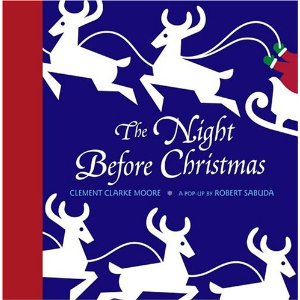
The Night Before Christmas by Robert Sabuda

A Pukeko in a Ponga Tree: A New Zealand Twelve Days of Christmas by Kingi Ihaka
Illustrated by Dick Frizzell

The Nutcracker by E.T.A. Hoffman
Illustrated by Maurice Sendak

Mole Family Christmas by Russell Hogan
Illustrated by Lillian Hoban

It's Christmas David by David Shannon

The Best Christmas Pageant Ever by Barbara Robinson
Illustrated by Laura Cornell

Finally, a piece of my favorite Christmas movie, Santa Claus: The Movie. No this is not the Tim Allen one, but when I was a kid, I thought it was magical. I continued to watch it far past when I quit believing in Santa. I still root for the reindeer as they try to perform the super duper looper.


Finding Ethnicity in the Christmas Story

I need a little help from you, my dear readers. Although many of you remain silent, leaving few comments, I know you are out there because well...let's be honest I can see everyone who visits my blog. So I know there are many of you. Normally, I consider myself rather good at google searching, but with this particular subject I am coming up short so I call upon your expertise.

Recently, a customer came into the store looking for a book on the First Christmas, with one caveat, she wanted Jesus and by extension, his family, to look like they were actually Middle Eastern. "Of course, right this way," I said to the nice white lady with her adopted Ethiopian child in tow. (she informed me that this one of the reasons for looking for such a book on the way to the children's department) But what to my wondering eyes should appear....but a mass of First Christmas books with a very white, or at best, slightly tan baby Jesus. To be fair, this isn't the middle ages so luckily I did not see any blond Jesus' and Mary, Joseph, and the shepherds seem to be wearing historically accurate clothing for the most part. But I don't think I could categorize a single one of them as middle eastern looking in any way shape or form. So I apologized to the customer and still bothered by this, came home and began to look for this picture book for surely it exists. So far I have found one book that I think fits this description, at least from the cover art. This saddens me greatly. In the 21st century why is it that Jesus is still, for the most part, white? Is there a sub-genre of books that I am just not finding? Help me dear readers for I know you are out there. Are there First Christmas/Nativity stories in which the illustrations reflect historical accuracy as well as ethnicity?

Back to the Classics

Sometimes I get tired of all this new fangled stuff. Not that books written today aren't written well, but sometimes I yearn for that classic lingo, the overly detailed paragraphs, and the lyrical way in which words jump from the page. I have spent the past few years reading new book after new book often feeling guilty when I want to re-read a classic (or something classic to me) because I know that this blog is sitting here and my readers want new books. Perhaps it is time to go back to the classics though, help children re-discover the magic of Peter Pan and The Secret Garden. The beauty of Heidi or adventure in The Enchanted Castle.

As an author, I am constantly told how important beginnings are, how you must find that perfect hook that will grab the reader and make them want to read the next sentence and paragraph and page. However, the classics defy this logic, which frankly makes me happy. You mean kids can read books that don't begin with some hook that defies logic? So here are the openings to some of my favorite classics, which are fantastic and I have read in the past few weeks.

The Secret Garden by Frances Hodgson Burnett

When Mary Lennox was sent to Misselthwaite Manor to live with her uncle everybody said she was the most disagreeable-looking child ever seen. It was true, too. She had a little thin face and a little thin body, thin light hair and a sour expression. Her hair was yellow, and her face was yellow because she had been born in India and had always been ill in one way or another. Her father had held a position under the English Government and had always been busy and ill himself, and her mother had been a great beauty who cared only to go to parties and amuse herself with gay people. She had not wanted a little girl at all, and when Mary was born she handed her over to the care of an Ayah, who was made to understand that if she wished to please the Mem Sahib she must keep the child out of sight as much as possible. So when she was a sickly, fretful, ugly little baby she was kept out of the way, and when she became a sickly, fretful, toddling thing she was kept out of the way also. She never remembered seeing familiarly anything but the dark faces of her Ayah and the other native servants, and as they always obeyed her and gave her her own way in everything, because the Mem Sahib would be angry if she was disturbed by her crying, by the time she was six years old she was as tyrannical and selfish a little pig as ever lived. The young English governess who came to teach her to read and write disliked her so much that she gave up her place in three months, and when other governesses came to try to fill it they always went away in a shorter time than the first one. So if Mary had not chosen to really want to know how to read books she would never have learned her letters at all.


Peter Pan by J.M. Barrie

All children, except one, grow up. They soon know that they will grow up, and the way Wendy knew was this. One day when she was two years old she was playing in a garden, and she plucked another flower and ran with it to her mother. I suppose she must have looked rather delightful, for Mrs. Darling put her hand to her heart and cried, "Oh, why can't you remain like this for ever!" This was all that passed between them on the subject, but henceforth Wendy knew that she must grow up. You always know after you are two. Two is the beginning of the end.


Heidi by Johanna Spyri

From the pleasantly situated old town of Mayenfeld a footpath leads up through shady green meadows to the foot of the mountains, which, as they gaze down on the valley, present a solemn and majestic aspect. Any one who follows it will soon catch the pungent fragrance of grassy pasture lands, for the footpath goes up straight and steep to the Alps.


The Enchanted Castle by E. Nesbit

There were three of them Jerry, Jimmy, and Kathleen. Of course, Jerry's name was Gerald, and not Jeremiah, whatever you may think; and Jimmy's name was James; and Kathleen was never called by her name at all, but Cathy, or Catty, or Puss Cat, when her brothers were pleased with her, and Scratch Cat when they were not pleased. And they were at school in a little town in the West of England the boys at one school, of course, and the girl at another, because the sensible habit of having boys and girls at the same school is not yet as common as I hope it will be some day. They used to see each other on Saturdays and Sundays at the house of a kind maiden lady; but it was one of those houses where it is impossible to play. You know the kind of house, don't you? There is a sort of a something about that kind of house that makes you hardly able even to talk to each other when you are left alone, and playing seems unnatural and affected. So they looked forward to the holidays, when they should all go home and be together all day long, in a house where playing was natural and conversation possible, and where the Hampshire forests and fields were full of interesting things to do and see. Their Cousin Betty was to be there too, and there were plans. Betty's school broke up before theirs, and so she got to the Hampshire home first, and the moment she got there she began to have measles, so that my three couldn't go home at all. You may imagine their feelings. The thought of seven weeks at Miss Hervey's was not to be borne, and all three wrote home and said so. This astonished their parents very much, because they had always thought it was so nice for the children to have dear Miss Hervey's to go to. However, they were "jolly decent about it , as Jerry said, and after a lot of letters and telegrams, it was arranged that the boys should go and stay at Kathleen's school, where there were now no girls left and no mistresses except the French one.


Anne of Green Gables by L.M. Montgomery

Mrs. Rachel Lynde lived just where the Avonlea main road dipped down into a little hollow, fringed with alders and ladies' eardrops and traversed by a brook that had its source away back in the woods of the old Cuthbert place; it was reputed to be an intricate, headlong brook in its earlier course through those woods, with dark secrets of pool and cascade; but by the time it reached Lynde's Hollow it was a quiet, well-conducted little stream, for not even a brook could run past Mrs. Rachel Lynde's door without due regard for decency and decorum; it probably was conscious that Mrs. Rachel was sitting at her window, keeping a sharp eye on everything that passed, from brooks and children up, and that if she noticed anything odd or out of place she would never rest until she had ferreted out the whys and wherefores thereof.

illustrated by: www.tracybishop.com